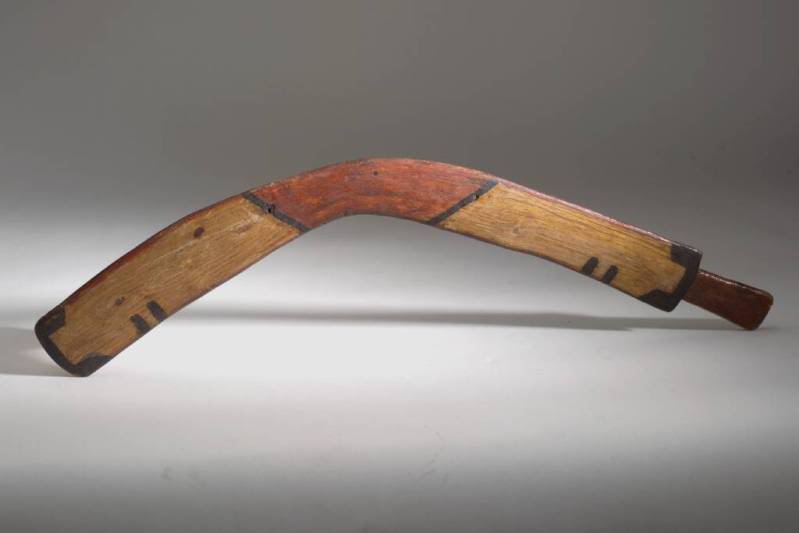
History of the boomerang, Origins, Evolution, and Culture
Today, the boomerang is known around the world as an object that returns to the person who throws it. However, its history is much older and more complex.
Used for thousands of years in various forms, the boomerang has, over time, become a cultural, sporting, and popular object, particularly associated with Australia.
What is the origin of the boomerang?
Contrary to popular belief, the boomerang did not necessarily originate in Australia.
Ancient throwing sticks have been found in various parts of the world. Some archaeological evidence suggests that throwing objects already existed in Europe, Egypt, and elsewhere long before modern times.
Australia nevertheless remains central to the history of the boomerang: Aboriginal peoples developed many different types of throwing sticks and boomerangs, which were used according to region and need.
Boomerang and throwing stick: What's the difference?
Not all throwing sticks are boomerangs that come back.
Some models were designed to be launched over long distances or for hunting and did not return to their launcher.
The returning boomerang, on the other hand, has a shape and aerodynamic profile that allow it to follow a curved trajectory and return to the launch point.
This distinction is essential to understanding the evolution of the different types of boomerangs.
The Boomerang in Ancient Cultures
Boomerangs and throwing sticks have had many uses throughout history:
hunting;
skill and dexterity;
training;
ritual activities;
music and ceremonies;
a demonstration of expertise.
In Australia, the boomerang has become a particularly powerful cultural symbol, associated with the history and traditions of many Aboriginal peoples.
Why does the boomerang come back?
A boomerang's return depends on its shape, its aerodynamic profile, its spin, and the way it is thrown.
When a boomerang returns, it follows a curved path that can vary greatly depending on the model and the conditions under which it is thrown.
It is this combination of rotation and aerodynamics that gives the boomerang its unique behavior.
From the traditional boomerang to the sports boomerang
The modern boomerang is no longer limited to its traditional use.
Since the 20th century—and particularly with the rise of modern competitions—boomerang throwing has become a full-fledged sport.
Today, various models are designed based on their range, accuracy, speed, flight time, or behavior in the wind.
[Discover our high-performance boomerangs]
[How to Throw a Boomerang: A Complete Guide]
The Boomerang Today
Today, the boomerang is used as an outdoor activity, a cultural artifact, a decorative item, and a piece of sports equipment.
A Story That Continues
The history of the boomerang, therefore, is not limited to the image of an Australian object that automatically returns to the thrower's hands.
It is a story of throwing sticks, traditions, experimentation, culture, and sports.
Understanding this history also helps us better appreciate the variety of boomerangs available today.